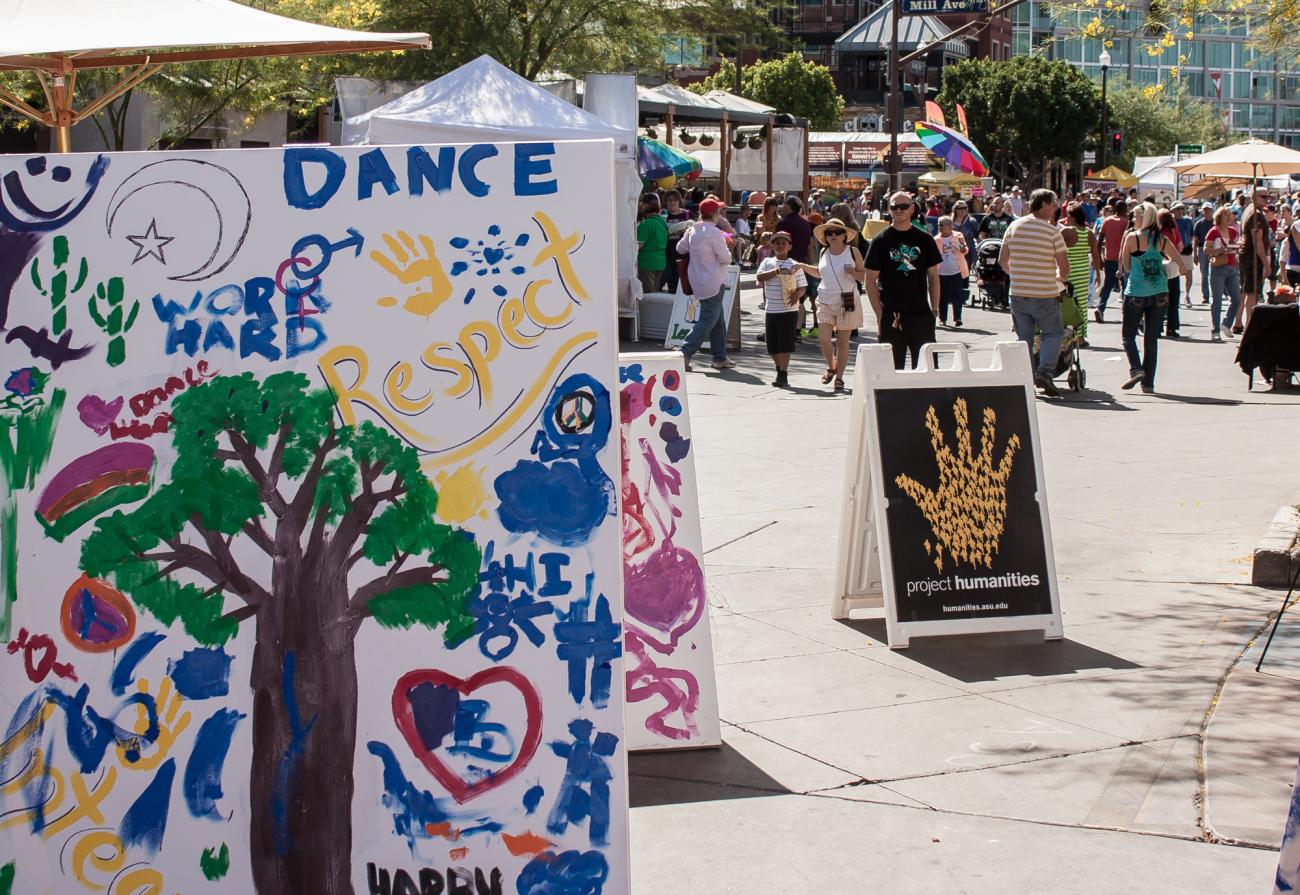
Perils and Perks of Privilege - A Workshop Series
Responses to social/ political issues--profiling, voter/ marriage rights, immigration, healthcare, education, and entitlements--are often restricted to individuals’ experiences. Many are unaware of the perils and perks of privilege that inform personal responses and viewpoints. Conversations on important issues through the lens of race, gender, sexuality, class, age, or ability, for instance, often leave individuals and communities unwilling/ unable to talk, listen and connect.
Project Humanities hosted 2-hour workshops that explored everyday manifestations of privilege. Workshops across Arizona engaged literature, history, language, performance, art, film, history, and popular culture to demonstrate the everyday complexities of privilege. Facilitated by experts who establish guidelines and appropriate prompts, workshops centered on participants’ vital voices, providing a model for understanding and acknowledging privilege.
These facilitated workshops centered on participants’ vital voices, providing a model for understanding “difference,” identity politics, and acknowledging privilege. Consistent feedback across all of the workshops evidenced individual empowerment through critical conversation, information, education, and self-reflection.
These workshops have now evolved to be Humanity 101 in the Workplace: Lessons in Privilege and Bias.
Goals
- Create an awareness of the multiple perils and perks of privilege.
- Examine one’s own perceptions, values, and biases.
- Create strategies for combating systemic biases.
- Enhance personal understanding and skills for living in an increasingly diverse world.
Ground Rules
- Everyone had the right to pass if asked a question they do not want to answer.
- No physical or verbal attacks.
- Keep an open mind.
- Everyone had the responsibility to involve themselves in activities and exercises, and making sure everyone in the group is comfortable with the group’s actions.
- Whatever is said by participants during session should be respected and not repeated outside of session.
- Only one person spoke at a time so that we could best understand everyone.
Resources
Resources
Able-Bodied
Articles
- Why I will start including accessibility information in my restaurant reviews - An occasional look at my communication with readers.Never mind what’s on the menu. A number of readers have told me my reviews would be more helpful if I let them know whether they can simply get through the door.By Tom Sietsema, Washington Post, 05/22/2019
- Common phrases rob the mentally ill of dignity - Ahwatukee Foothills News (11/29/2017)
- Let’s Talk About Ableism: What It Means, And Why Everyone Should Care - When my son was born, he was perfect — ten little fingers, ten little toes; tiny, exquisitely formed features. He was the most beautiful thing I’d ever seen. He and I were like other mamas and babies in that way. While I believed then (and still believe now) that he was the most perfect and beautiful baby ever born, I’m fairly certain that is a sentiment held by most new mothers.
- We Need to Start Recognizing Ableism as the Serious Issue It Is - Guest post by Persephone Smith-Donohoe, 14 year old disability advocate, musician, martial artist, dancer, and big sister. This essay was originally written as an 8th grade assignment and was voted Best Presentation by Persephone’s classmates and went on to become an inspiring speech presented to students and teachers.
- Unalterable: On Accepting Myself as a Queer Person with Dwarfism - Author describes how she accepted herself in a privileged culture that made her try to shut off her mind and wish she didn't exist. - Leslie, 07/05/2014
- Court Throws out "Mental Retardation" - US Supreme Court unanimously votes to eliminate phrase, "mental retardation," from its terminology. - Tony Mauro, USA Today, 06/01/2014
- It's OK To Be An Older Worker As Long As You Don't Lose Your Job - Americans who are 55 years or older have the lowest unemployment rate of the nation, but if someone from that same demographic were to lose their job they remain unemployed for the longest of any age group. The average age of retirement has gone to 61 years of age, while the percentage of individuals working past 65 has also gone up. - Allison Linn, 9/5/2013
- 15 Things Never to Say to a Special Needs Parent - 02/05/2014
- 19 Examples of Ability Privilege - Shannon Ridgeway, 03/05/2013
- Here's When It's OK To Use The 'R-Word' In 1 Nifty Chart - Eleanor Goldberg, 10/29/2014
- Blind Couple Denied Bus Seats - KCPQ, 12/30/2014
- My Son Is Black and Has Autism, and I'm Afraid - David Dennis, 12/30/2014
- 5 Thing Not to Do When Interacting with Physically Disabled People - Erin Tatum, 08/01/2014
- 10 Questions About Why Ableist Language Matters, Answered - Rachel Cohen-Rottenberg, 11/07/2014
- Feds: Shaw University discriminated against disabled student - Angie Basiouny, 07/15/2015
- 6 Common Forms of Ableism We Need To Eliminate Immediately - Julie Zeilinger, 08/19/2015
- A mom's post about a Halloween costume is going viral on Facebook. Thank you, Target! - Laura Willard, 10/22/2015
- Lego, In A First, Will Unveil A Minifigure In A Wheelchair - Bill Chappell, 01/28/2016
- 5 Examples of How Privilege Lists Often Ignore the Intersection of Dis/Ability - Cara Liebowitz, 02/02/2016
- 19 Examples of Ability Privilege - Shannon Ridgway, 03/05/2013
Videos
- Experience for 60 Seconds how the World Looks, Sounds, and Feels to Someone with Autism - These two videos describe autism and how people with autism experience the world. - Rajiv Narayan
- You Don't Use the 'N' Word. Why Do You Use the 'R' Word? - Looking at the way people use the word "retard" in terms other than a medical diagnosis. - Brandon Weber, 5/20/2011
- WWYD? Girl With Speech Disorder Bullied! What Would You Do - 8/15/2013
- Woman With Facial Defect Humiliated | "What Would You Do?" - A woman with a very noticeable birthmark on her face is humiliated by the makeup artist who refuses to put make up on her. What would you do?
- Elders Bullied At The Grocery Store | "What Would You Do?" - A senior citizen cashier is bullied by customers for moving too slow. How will people react?
- WWYD? Autistic Child Defended in Café - When a man criticizes a family with an autistic child, bystanders step in.
- Stealing from the blind: What would you do? - 5/8/2010
- Pro Infirmis «Because who is perfect?» - Disabled mannequins will be eliciting astonished looks from passers-by on Zurich's Bahnhofstrasse today. Between the perfect mannequins, there will be figures with scoliosis or brittle bone disease modeling the latest fashions. One will have shortened limbs; the other a malformed spine. The campaign has been devised for the International Day of Persons with Disabilities by Pro Infirmis, an organization for the disabled. Entitled "Because who is perfect? Get closer.", it is designed to provoke reflection on the acceptance of people with disabilities. Director Alain Gsponer has captured the campaign as a short film.
Age
Articles
- 'OK, boomer!' Supreme Court hands partial victory to federal worker claiming age discrimination - WASHINGTON – The Supreme Court ruled Monday that federal workers may be able to win some relief for age discrimination even if it was not the sole reason for action taken against them. - Richard Wolf, USA TODAY, 04/06/20
- Because I Said So - Adult Privilege and a Society Against Children - “Take this to the dirty clothes basket,” I remark absently to my seven-year-old, holding up my dusting cloths. She looks up from the incredible secret compartment LEGO project she’s in the middle of building, and I cringe to myself. “I’ve got it; you keep working!” She grins at me, shakes her head and continues to build something I will have trouble figuring out later – which is one of the reasons she loves it so much. - Sara Schmidt, life.ca
- ADULT PRIVILEGE AND DISCRIMINATION AGAINST CHILDREN’ - The funny thing about in-built privilege is that so-often the bearers of said-privilege really have no idea that they are exercising it or that they have come to feel themselves entitled to it. - CrystyClark.com , 05/17/2010
- OPINION: Don’t Call Me ‘Young Lady’ - The strapping blond’s smile glinted as he handed me my boarding pass and luggage sticker. “There you go, young lady!” - Karen Grassle, Next Avenue, 07/31/2019
- Hillary Clinton is too Old for What? - In response to Charlie Cook's critical article on Hillary Clinton's age, this article discusses how ageism and sexism often work together to amplify discrimination. - Froma Harrop, The Seattle Times, 02/20/2014
- Faygo Accused of Age Discrimination--by Founder's Grandson - Hugh Rosenthal is suing Faygo for age discrimination, after the company allegedly fired him for being 68-years-old and hired a much younger man to replace him. - Tresa Baldas, Detroit Free Press, 06/23/2014
- 20+ Examples of Age Privilege - Lists several privileges associated with age. - Shannon Ridgway, 01/24/2013
- Coming Out Old: Issues of Ageism and Privilege - Article describes how people are affected from ageism throughout their lives and provides examples of acts of ageism. - Dorothy Jean Furnish
- Discriminate Against the Old? Even the Old Do It - Article examining age discrimination and its effects in the workplace. - Helaine Olen, The New York Times, 03/24/2014
- 13 'Old People' Halloween Costumes that are Truly Scary -Shelley Emling, 9/28/2015
Videos
- A Reporter Asks Madonna a Question Everyone Else was Afraid to. She Gives a Kick-Ass Reply - Madonna discusses stereotypes of ageism, including stereotypes about sexuality and behavior. - Darcie Conway, Upworthy
- Funny Prayer about Getting Old - Mary Maxwell delivers invocation as well as several jokes on aging. - HomeInsteadInc, 04/07/2010
- WWYD? Young American Teens Harassing Older Adults - What Would You Do? creates scenario in which teenagers harass older adults in order to see how people will respond. - mrduckbears24, 01/31/2014
- Ageism in Silicon Valley - Discussion about struggles for those over 40 applying to jobs in technology. - CNBC, 03/24/2014
- When Growing Old Makes You Invisible as a Gay Person- Queery 11/09/2015
Other
- Humor and Aging - PowerPoint presentation - Don L.F. Nilsen, Assistant Dean, Division of the Humanities, ASU Emeritus College
- Put the elderly in prison visual.
- Growing older visual.
- Humor and Aging - PowerPoint presentation - Don L.F. Nilsen, Assistant Dean, Division of the Humanities, ASU Emeritus College
- Put the elderly in prison visual.
- Growing older visual.
Black Male
Articles
- The Reality Of Black Male Privilege - Embarking the 50th anniversary of the March of thousands of African Americans came together to discuss social inequalities. Despite that the community itself faces privileges between the black male and b lack female. African American communities hold a hierarchy within itself. Social issues are represented and associated around the black male, while black females are left unregarded. - Theodore R. Johnson, 8/30/2013
- Black Male Privilege? - A new look at the cross section of race and empowerment as it relates to black men has spelled out a new theory that one sociologist dubs "black male privilege." Host Michel Martin speaks with L'Heureux Lewis, assistant professor of sociology at the City University of New York, for more on why he thinks black male privilege exists. - NPR, 03/04/201
- There's Nothing Funny in the Misogynoir of Crossdressing Instagram "Comedians"- Hilary Christian, 9/29/2015
Christian
Articles
- South Dakota Public Schools Add 'In God We Trust' Signs To Walls - NPR, 07/2019
- 30+ Examples of Christian Privilege - Sam Killerman, 08/2014
- Here Are 3 Examples of Christian Privilege – And How You Can Challenge It - Ellen Friedrichs, 06/15/2015
Cisgender
Videos
- The Whittington Family: Ryland's Story - The Whittington family describes their young son's gender transition. - TheWhittingtonFamily, 05/27/2014
- Transgender female workers face added discrimination - Ashley Milne-Tyte, 06/30/2014
- Is Your Trans Allyship Half-Baked? Here Are 6 Mistakes That Trans Allies Are Still Making - 06/22/2015
Articles
- Transgender People want to Exist without having to Prove they are Real - An interview with Janet Mock, whose memoir and infamous interview with Piers Morgan have brought to light issues with how the media and society address transgender people. - Jessica Valenti, The Guardian, 06/20/2014
- Things You Wanted to Know about Trans People and were Rude Enough to Ask - The author explains how the privileged position of cisgender individuals allows them to ask trans people invasive questions. - Fred McConnell, The Guardian, 03/18/2014
- Gabourey Sidibe Repeatedly Uses The Word 'Tranny' On 'Arsenio Hall Show' - Actress Gabourey Sidibe repeatedly used a transphobic slur when she recently visited "The Arsenio Hall Show" to discuss living in New Orleans. - HuffPost, 02/01/2014
- 'I don’t need a penis to feel like a dude' - Buck Angel describes his experiences as a trans man and activist. - Annabel Ross, 02/05/2014
- Piers Morgan Misgenders Janet Mock on CNN, Insults Her on Twitter - When trans woman, author Janet Mock visited CNN’s Piers Morgan Live to talk about her memoir Redefining Realness, Piers Morgan misgenders her, resulting in a heated battle on Twitter. - Mey, 02/05/2014
- Maine Supreme Court Rules in Favor of Transgender Girl in Orono School Bathroom Case - The Maine Supreme Court has now declared that a trans girl must be allowed to use female facilities. - Judy Harrison, BDN, 01/30/2014
- How Piers Morgan should have handled transgender author Janet Mock - The author suggests three things that could have made the interview more acceptable to Mock and viewers. - Robin Abcarian, LA Times, 02/06/2014
- 'My daughter wants to be a boy': Australian mother tells how her eight-year-old asked if she could go to the doctor to get a penis - Mother describes her experiences with her child's gender identity. - Daily Mail Reporter, 03/12/2014
- 6 Steps to Explaining Your Transgender Identity to Your Immigrant Family - A helpful six step process in which helps individuals "come out" to their family members. The author goes over how these six simple steps are what she has learned from her personal experiences and feels as it can come helpful to anyone else going through this process. Although the article focuses on Transgender and Immigrant Families these steps are general enough to be applied in all use. - Amy Sun, 10/10/2013
- Are Transpeople Proud? A Personal Viewpoint on Pride and Self-Acceptance - Author describes pride and shame in the trans community. - Deja Nicole Greenlaw, 05/03/2013
- Fear and Loathing in Public Bathrooms, or How I learned to Hold My Pee - Ivan E. Coyote, 04/11/2014
- Stuff Cis People Say to Trans People - Transfix, 10/02/2014
- 8 Myths About Transgender Men's Genital Reconstructions - Mitch Kellaway, 10/25/2014
- Pondering Male Privilege Post-Transition - Brynn Tannehill, 11/14/2014
- Transgender Student's Family Sues Michigan School Districts For Discrimination - Kate Abbey-Lambetz, 12/23/2014
- 10 Things You’re Actually Saying When You Ignore Someone’s Gender Pronouns - Sam Dylan Finch, 10/31/2014
- 7 Tired Phrases That Marginalize Trans People - And What to Use Instead - Adrian Ballou, 02/03/2015
- Fla. bathroom bill would require transgender people to prove legal gender - 03/05/2015
- Coming Out as Genderqueer Non-Binary (Outside Of and Within the Queer Community) - Michal 'MJ' Jones, 04/18/2015
- Boy, Girl, Neither, Both? Why Assuming Is Awkward (And What to Ask Instead) - Adrian Ballou, 05/01/2015
- Mike Huckabee's Creepy Transgender 'joke' - Sally Kohn, 06/03/2015
- The Caitlyn Jenner Paradox: Anti-Transgender Violence Soars Despite Star Power - Jennifer Gerson Uffalussy, 06/23/2015
- 5 Questions Cis People Are Still Asking About Why Trans-Inclusive Language Matters, Answered - Maddie McClouskey, 10/20/2015
- How to Support your Child who is Questioning their Sexuality - Ellen Friedrich, 11/11/2015
- 4 Reasons Social Justice Orgs Should not be Lead Only by Straight, White, Cis Men - Carmen Rios, 11/08/2015
- Here are 20 Examples of Cissexism that We've Probably all Committed at Some Point - James St. James, 11/09/2015
- 7 Questions to Brace Yourself for When You Explain Polyamory to Your Family - Ginny Briwn, 11/10/2015
- These Messages from Trans Teens to their Future Selves will Touch your Heart - Mashable, 11/11/2015
Other
- HOW TO BE A SAFE SPACE FOR TRANS* PEOPLE - Students for TRANS* rights and Progress
- Our Trans Children - A Publication of the Transgender Network of Parents, Families and Friends of Lesbians and Gays (PFLAG)
Class
Class Privilege
3 ways to responsibly and compassionately respond to panhandling
Class Privilege:
I’ve moved to the other side of the street to avoid it. I’ve lowered my eyes so that I didn’t have to acknowledge it. I’ve brushed it off with excuses to make me feel a little less guilty.
When I’m being honest, panhandling makes me uncomfortable.
As a woman, I’m generally uncomfortable around anyone demanding my attention on the street. But besides those who are catcalling, there’s a certain population I’ve ignored because I’ve often felt helpless or unsure of what to do — until now.
Panhandling is when people ask for money in public spaces. Most panhandlers (although not all) are experiencing homelessness. In many cities, panhandling is considered free speech and is protected by the first amendment. Many of us encounter those who are panhandling on a daily basis.
We know they deserve compassion, but we may not know how best to give it. How should we respond to people panhandling or experiencing homelessness?
Here is an easy step-by-step guide to responding responsibly and compassionately to those who are panhandling.
1. Say ‘Hello’
Most people don’t even recognize that the person panhandling is a human. For many, we’ve been so conditioned to disregard and not care about homelessness that the brain chemically responds to that person on the street as if they weren’t a person at all.
These are people trying to survive. And at best, we treat them like a nuisance. You can help those who are panhandling by just recognizing that person’s humanity.
Consider that other people passing by on the street are mostly ignoring these people panhandling. Some people are even verbally and physically attacking them for panhandling.
The violence towards those experiencing homelessness has continued to increase.
Can you imagine what it would be like to be spit on and have insults hurled at you all day, every day? After being questioned and humiliated all day, simple eye contact and a smile from a stranger can go a long way.
It may feel uncomfortable acknowledging them — especially if you don’t have money to give — but that’s a personal issue.
After making a concerted effort to unpack this feeling, I realized that the reason I feel uncomfortable when I see a person panhandling or a person experiencing homelessness is because it reminds me of my privilege.
I don’t have to sleep outside or ask for money to meet my most basic needs. And it’s hard to accept that other people do.
But my privileged comfort is not more important than their humanity.
I can do my part in supporting those who are panhandling by simply reminding myself that they are human. I may still feel sad, upset, and uncomfortable, but I no longer allow those emotions to make me turn away from the reality that there is still a person in front of me.
Look them in the eye. Give them a nod. Give them a friendly smile. Wish them a good day. Do whatever you can to acknowledge your fellow human beings.
2. Give (If You Can)
People are panhandling for a reason. Regardless of what this person might have done before, their basic living needs are not being met in the present.
Some individuals who have survived from panhandling have admitted that it is a very degrading experience, and doing so is often the last resort.
While we might see stories in the media about people pretending to be homeless, asking for money, and then zooming away in their convertible, that is truly not the case for the majority of people panhandling on the street.
Don’t let a few high-profile liars keep you from giving to the millions of disenfranchised people.
Many people also hesitate to give money out of fear that it will “support their addiction.”
First of all, this fear is vastly overstated. In a recent study of people panhandling in San Francisco, 94% disclosed that they spend the money they collect while panhandling on food. Less than half admitted to spending that money on drugs or alcohol.
Secondly, while many people, homeless or not, are struggling with addictions, we shouldn’t police where our money goes if we give it away.
When we give our dollars directly to these people, we are empowering them to make a choice, and we have to trust that they will make the best choice for themselves while they live in these extreme conditions.
Unless we have experienced the same circumstances, we cannot judge or assume we know what’s best for their situation.
For example, a person who has experienced homelessness shared with me that drinking a bottle of wine was enough to make them feel warm enough to sleep through another freezing winter night outside.
It’s not ideal (ideally, they would have access to warmer clothes — or, you know, a home), but it’s what they could afford and it helped them survive. We have no right to judge that.
There are also a number of things that services for those experiencing homelessness can’t provide.
Shelters, food pantries, and local support groups alone can’t provide things like flashlight batteries or cell phone minutes, for example. Your money could very well be going toward these necessary items.
If you are able to help financially, but still don’t want to give your money to them directly, you could ask what they specifically need and see if you could help provide that.
Consider purchasing gift cards to restaurants nearby or keeping a few Ziploc bags full of things like toiletries and snacks in your car for these occasions.
Depending on where you live, you might see the same individuals every day. If you feel comfortable enough, maybe invite them to join you for a meal somewhere. It’s okay to establish a relationship, even if you can’t give your time or money every day.
Remember that it’s okay to say “no,” too. But if you are able and feel called to give someone panhandling money, then give.
Know that your money is going to be spent on the best choice for them.
3. Get Involved
So you’ve overcome the dehumanizing mindset, and you’ve given to a person for short-term relief from extreme circumstances. That’s great! But how can you address these problems more proactively going forward?
Get involved.
Volunteer
Volunteering with local organizations working to prevent and end homelessness is a great way to support your local community and those who are panhandling.
While the winter holidays are when people are feeling the most charitable, volunteers are needed year round. Ask your local organizations when they need help, and get creative using your own unique talents and skills to assist them.
Get Educated About the Causes
We know that there are many reasons why people become homeless.
Nationally, there is a shortage of affordable housing. Even those working full-time earning minimum wage cannot afford the rising cost of living in this country to support their families.
On top of our failing systems, homelessness is becoming criminalized nationally. Laws are being passed that prohibit life-sustaining activities such as sitting, eating, and sleeping in public spaces.
Even trespassing ordinances ban people with “scent that is unreasonably offensive to others.” For this specific law, not only can people be banned and punished for being “too smelly,” but also for trying to wash themselves in public bathrooms.
In the last year alone, at least 31 cities nationwide have tried to restrict or ban groups from passing out or sharing food in public.
Besides the laws that are trying to hide these people experiencing homelessness, there are no laws protecting the homeless population from hate-crimes.
Advocate
As a college student, my budget and time to volunteer on-site are both limited. However, I can do my part to help end violence against and criminalization of panhandling and homelessness by educating myself and lobbying on my own schedule.
My local Homeless Coalition directs me with letter writing, sending e-mails, and making phone calls to our local officials who can prevent these laws that criminalize homelessness from passing.
I can also respond to and prevent others from harassing and trying to stop people that are panhandling if I know my local laws and ordinances.
***
While encountering those who are panhandling may be initially uncomfortable for me, I have to remember that those people are living in conditions much worse than discomfort.
I no longer dismiss or blame these individuals for their circumstances, but instead, attempt to do my part to provide support — both immediate and sustainable — for the people in my community.
Responding responsibly and compassionately to panhandling allows for a bigger movement to prevent homelessness from happening and helping all of those experiencing homelessness and who panhandle.
Gender
Videos
- Maid Cafe brings Japanese Anime Fetish to NY - Employees at the Maid Cafe in NYC dress in pink maid costumes and call the patrons "master" or "princess." Reuters interviews patrons and employees who explain and justify the appeal of the cafe. - Yahoo Screen
- A Public Service Announcement On Behalf Of All White Dudes - A short video on the inequality between white men over other men and women of different races. - Adam Mordecai, Time Wise, 08/02/2012
- Desperate Housewives - A scene from the show "Desperate Housewives" that implies that the worst thing that can happen to a woman's hair is an afro. - Mark Cherry, 03/21/2012
- How the Media Failed Women in 2013 - A video on how women are still being poorly represented and objectified in the media. Yet there were strides towards empowerment of women in 2013 we still must achieve better. - The Representation Project, 12/3/2013
- Humanity Has A Funny Way Of Erasing All Of The Moments In Women's History With Just 11 Letters - This video sure has a good point about humanity's baser instincts. Why can't we overcome them?
- Top 10 Most Sexist Commercials of All Time! - A list of what TheWatchDaily considers the top 10 most sexist commercials of the 50's & 60's. - TheWatchDaily, 10/25/2012
- I Cannot Believe These Men Think They Can Get Away With This In Front Of Our Eyes - "Egyptian anti-sexual harassment groups confirmed that mobs sexually assaulted and in some cases raped at least 91 women in Tahrir Square over four days of protests beginning on June 30, 2013 amid a climate of impunity" - Rossalyn Warren, 7/2/2013
- WWYD A Little Boy Painting His Nails Pink He's Turning Nancy On Me!! - 11/17/2013
- Gender Discrimination at Job Interview - "Shark Tank" investor Barbara Corcoran intervenes when our "employer" shows gender bias.
- Wild Wife - A clip of the 1954 cartoon short called "Wild Wife". - Dailymotion, 5/7/2011
Articles
- Media: Invisible Women: Exposing Data Bias in a World Designed for Men - Many people are familiar with the classic symptoms of a heart attack: chest pain and shortness of breath. But what they might not realize is that about two-thirds of women exhibit less-typical symptoms, such as subtle pressure or tightness in the chest, rather than the male presentation of full-blown chest pain.
- The Hidden Bigotry of Crosswords - Last month, Sally Hoelscher published her first crossword puzzle in The New York Times. It was Presidents’ Day; the theme was memoirs by first ladies. Like lots of nerdy subcultures, the crossword puzzle has a buzzing ecosystem, and it whirred into action.
- Study: Math teachers show most bias against girls of color - New research into how teachers evaluate the mathematical ability of students suggests that White teachers and teachers of color alike have biases that favor White and male students.
- How Digital Virtual Assistants Like Alexa Amplify Sexism - By relying on biased information sources, virtual assistants in smart speakers could spread and solidify stereotypes..-By Morgan Meaker
- TSA Body Scanners Appear To Be Discriminating Against Black Women’s Hairstyles - According to a detailed ProPublica report, full-body scanners frequently give “false alarms” on Black women’s hair, an action some women say is discriminatory.-By Victoria M. Walker
- Video games' sexual double standard may have real-world impact - This article talks about how the gaming industry's over sexualization of female characters can have an adhere affect on the real world. Gaming Industry justifies it's use of Barbie like proportions as stating that is what the audience wants. But studies conducted by Ohio State University and Stanford's Jeremy Bailenson have concluded that women who played or associated themselves with hypersexualized avatars were at higher risk to fall victim to myth rape statements. - Yannick LeJacq, 10/20/2013
- Raising My Rainbow - This is a reflection of the authors desire to be a good parent to her twin boy and girl. Like a typical parent they are always searching for some form of guidance or knowledge to be the very best. He then one day ran across the novel Raising My Rainbow which followed C.J. who is a gender fluid 5 year old boy. The rest is an excerpt of the book. - Raising My Rainbow: Lori Duron Forward: David Burtka & Neil Patrick Harris, 9/3/2013
- Understanding Gender Nonconforming Children - Goes over the social acceptance of gender and gender fluidity. It is acceptable for a girl to be playing sports, but a boy who is interested in Barbies or anything else that society considers feminine, will be ridiculed and bullied. It goes more into detail on how these issues impact their schooling. - Susan Page, 9/5/2013
- Does Gender Matter When Casting Voice Talent - An article looking at how gender affects the effectiveness of a voice commercial. - Chris Porter, 3/25/2010
- What You're Really Saying When You Call Me A Bitch - An analysis of how people signal their displeasure and the real meaning of the insult "bitch". - Emily Heist Moss, 10/31/2013
- Prudence Doesn't Know Best About Rape Prevention: 3 Actual Tools - Outlining ways to prevent rape without victim blaming. - Lauren R. Taylor, 10/28/2013
- I'm Only Friends With Boys - Angelina LB, 10/27/2013
- 8-Year-Old Gets Sexist 'How To Survive Almost Anything' Books Pulled Off The Shelf - Constance Cooper and her daughter KC were wandering a bookstore when KC noticed two books "How to Survive Anything". Each aimed towards a specific gender the eight year old KC was appalled by the sexism within the two books. The boys version addressed serious life issues such as surviving a tornado while the girls version had chapters on teaching your cat to sit. Constance and soon a bookstore clerk immediately removed the books off the shelves. - Mandy Velez,10/4/2013
- They Tried To Make This Pop Star Dress And Sing A Certain Way. She Refused And Said These Words - An Interview with R&B singer Janelle Monae on her experiences with sexism. She states her opinion on expression and how she feels like women should break those gender roles and social constructs for a women to act, dress, or say a certain thing. - Rossalyn Warren, 7/4/2013
- The Presumed Funniness of Gender Ambiguity - Looking into why gender ambiguity is used as a source of comedy. - 1/13/2014
- Infographic: How to win a Best Actress Oscar (spoiler alert: play a wife) - An article discussing infographics on how Oscar awards are divided by role for men and women. Majority of awards given to woman play mothers or sisters, more of a support role. While men are mainly given awards for playing historical roles which are more central to the film. - Katie Halper, 1/24/2014
- Barbie Doll - A poem reflecting on the social constructs for woman to be perfect to look like a doll. - Marge Piercy, 1/1/2004
- Cues From the Crib : By Speaking Softly to Daughters, Firmly to Sons, Experts Say Parents Can Reinforce the Gender Gap - A CHILD'S WORLD: What shapes the way we grow up. One in an occasional series. - May 20, 1992
- FOR EVERY GIRL… THERE IS A BOY…
- Landers: Beware of stereotypes - Have you ever been told that you would not be good at something because of your gender or age or race? - Denise Landers
- The Dinner Party - by Mona Gardner
- Young People Push Back Against Gender Categories - by Margot Adler - 7/16/2013
- Why Men Need Feminism Too - A different look on feminism through the eyes of men. - Katie Kreitler, 8/20/2012
Other
- Female Genital Mutilation - NPR Radio - 3/12/2004
- MANIGALE - A compilation of pictures with women stereotypically posing next to a motorcycle and a man posing in the same manner. - John Porter, 8/17/2012
- If You Still don't Think We Need Feminism, You Should See The Signs These Girls Were Bullied For - A series of photographs portraying why women think they need feminism. - Megan Kelly
General
Videos
- Check Your Privilege! - hypermele, 11/29/2014
Articles
- Change From Within Blog - Diversity and inclusion consultant Jamie Utt blogs about different types of privilege that affect everyday life. - Changefromwithin.org
- The Problem with “Privilege” - by Andrea Smith - 8/14/2013
- Project Implicit - Project Implicit provides consulting, education and training services on implicit bias, diversity and inclusion, leadership, applying science to practice, and innovation.
- 'Judging America' Photo Series Captures Nation's Sterotypes- Cavan Sieczkowski, 09/30/2014
- This Teacher Taught HIs Class A Powerful Lesson About Privilege - Nathan W. Pyle, 11/21/2014
- 5 Ways Marginalized People Can Recognize Their Privileges In Other Areas - Michal "MJ" Jones, 12/08/2014
- 4 Uncomfortable Thought You May Have When Facing Your Privilege - Robin J. Landwehr, 01/25/2015
- Privilege 101: A Quick and Dirty Guide - Sian Ferguson, 09/29/2014
Handouts
- Beauty must be defined as what we are, or else the concept itself is our enemy - 12/24/2009
- Your life is your life - Poem by Hank - Artwork by Nikki McClure
- The Privilege Whale - Ligne Claire
- Calling IN: A Less Disposable Way of Holding Each Other Accountable - editors, 12/18/2013
- Poetry Challenging Privilege - Peter J. Elliot, 03/18/2015
Other
- Baby K'Tan See the Difference? - Image of two Baby K'Tan products sparks controversy. More info
- Baby K'Tan "Proof" - Blogger posts photo of several Baby K'Tan products in attempt to prove packaging isn't racist. - Myne Whitman, Romance Meets Life, 06/26/2014
- Baby K'Tan Website Image - The image displayed on the Baby K'Tan website - Baby K'Tan, 06/26/2014
- Lists of privileges - Kyriarchy & Privilege 101, 2011
Heterosexual
Videos
- Stand Up at Work! - LGBT individuals share their experiences with bullying in the workplace. - BeLonG To Youth Services, 05/15/2014
- Homosexual PDA Turns Heads in Mississippi - What Would You Do? sets scene in Mississippi restaurant to test diners' responses to a gay couple's public display of affection. - ABC News, 05/31/2014
- Watch these Straight People Answer a Question Gay People Have Been Asked For Years - A series of straight people answer a question posed to gay people. - Rebecca Eisenburg, 2/14/2008
- Proud to Be Video (Stephen Fry) - After same-sex marriage is legalized in the UK, Stephen Fry talks about how he feels about being gay. - Proud2Be Project, 05/07/2012
- No Homophobes PSA- Homophobic language isn't always meant to be hurtful, but how often do we use it without thinking? Please share this video to help combat casual homophobia. -NoHomophobes, 1/3/2013
- Short Video on Homophobia- Short documentary on homophobia, made for a university project. -LGBT Documentary, 5/15/2012
Articles
- Unalterable: On Accepting Myself as a Queer Person with Dwarfism - Author describes how she accepted herself in a privileged culture that made her try to shut off her mind and wish she didn't exist. - Leslie, 07/05/2014
- Do You Want a Penis with Your Happy Meal? - Topher Payn raises the issue of McDonald's enforcement of gender roles with Happy Meal toys. - Matt Henie, 9/17/2013
- ‘Who’s the Man?’: Heteronormativity and Queer Relationships - People in queer relationships are often subjected to a barrage of ignorance from the straight community. Whether it be invasive sexual questions or unwanted criticism, nothing seems to be off limits to the innocently inquisitive straight.
- Race + Hip-Hop + LGBT Equality: On Macklemore’s White Straight Privilege - This article talks about hip hop singer Macklemore's role in the LGBTQ community as a privileged person. - Hel Gebreamlak, 03/06/2013
- The Unicorn in the Garden - James Thurber
- I Want a Wife - Judy Brady
- The Good Wife's Guide - Housekeeping Monthly, 05/13/1955.
- Slave Marriages - Most slave-owners encouraged their slaves to marry. It was believed that married men was less likely to be rebellious or to run away. Some masters favored marriage for religious reasons and it was in the interests of plantation owners for women to have children.
- TONI MORRISON: THE BIG BOX - Of the many ways that Ms. Magazine was groundbreaking, children's literature is not the first that comes to mind (if it comes to mind at all). But almost from its inception, Ms. Magazine included a feature called Stories For Free Children, stories for children meant as an alternative to the bulk of children's literature at the time that perpetuated stereotypes (often innocently) of gender roles
- The Wedding ceremony from the Anglican Book of Common Prayer - THE FORM OF SOLEMNIZATION OF MATRIMONY
- 'Marriage Is for White People' - Joy Jones, 03/26/2006
- Sealing the Sacred Bonds of Holy Matrimony Freedmen's Bureau Marriage Records - Reginald Washington
- Jumping the broom - Jumping the broom is a phrase and custom relating to a wedding ceremony where the couple jumps over a broom. The custom is historically associated with the Romani people of the United Kingdom, especially those in Wales, but it is now more widespread among African Americans
- Kids Lit - LGBT children's literature is coming of age and coming out of the closet. - Liz Massey
- Gay Sex is Gay Sex and Politically, That Matters - Jamilah King, 10/23/2014
- Tim Cook Speaks Up - Tim Cook 10/30/2014
- My Church Told Me To Pray The Gay Away - Russel Saunders, 02/18/2015
- Why Are The Majority Of Children’s Books Still About White Boys? - Soraya Cehmaly, 09/06/2013
- 10 Examples of Straight Privilege - Erin Tatum, 03/29/2015
- Multinational Study Uncovers Widespread Homophobia in Sports - Travis Waldron, 05/14/2015
- 10 Children's Books That Paved The Way For A New Queer Protagonist - Colton Valentine, 05/28/2015
- The Skinny of Body Shaming - Lisa Respers France, 06/06/2015
- Teacher resigns after reading students book about gay couple - Michael Biesecker, 06/16/15
- 10 examples of Straight Privilege - Erin Tamum, 03/29/2015
Handouts
- Can You Tell Just By Looking? - A flow chart designed to show people how to determine others sexuality. - Michelle Clement, Fall 2013
- Examples of Heterosexual Privilege - A checklist for heterosexual privilege. - 2012
Other
- 'Valentine Road': A Path To Teen Tragedy - Marta Cunningham went through four years of research on the case of Larry King and Brandon Mclnerney. In February 2008 Larry King asked Brandon Mclnerney to be his Valentine, in turn the very next day Brandon shot him in the back killing him. Larry himself was very gender fluid and would dress very feminine, he'd wear earrings dresses, high heels etc... With this research and case study she created an HBO documentary titled "Valentine Road" With this documentary she hopes to help the educations system and faculty adjust and be more acceptant of those who are coming out at younger ages. - NPR Staff, 9/30/2013
- Summer Film Series: 'no dumb questions' - July 18th 2013 - Burton Barr Library in Phoenix - Project Humanities Event
- Photo - BMW Commercial Poster
- "Same Love" Lyrics - Macklemore
- "Is Gender Identity Biologically Hard-Wired?" - Special correspondent Jackie Judd talks to families and researchers who are working on the science of gender identity. PBS News Hour
I want to talk about privilege today, because it's fundamental to most modern discussions of racism. And sexism, and ableism, and lookism, and classism, and dot dot dot. And because I've seen some pretty odd definitions of privilege out there. The standard resource on privilege is in White Privilege: Unpacking the invisible knapsack. But I think that resource is clearly not working for some people based on some very defensive reactions I've seen, so I'm going to be presumptuous and try on my own.
Privilege is not: About you. Privilege is not your fault. Privilege is not anything you've done, or thought, or said. It may have allowed you to do, or think, or say things, but it's not those things, and it's not because of those things. Privilege is not about taking advantage, or cheating, although privilege may make this easier. Privilege is not negated. I can't balance my white privilege against my female disadvantage and come out neutral. Privilege is not something you can be exempt from by having had a difficult life. Privilege is not inherently bad.
Privilege is: About how society accommodates you. It's about advantages you have that you think are normal. It's about you being normal, and others being the deviation from normal.
Almost everyone who is reading this had some form of privilege. If you’re a member of three marginalized groups, in ill health, and poor, you're still able to access and use the internet, both demonstrating and conferring privilege.
Some privileges are easy to demonstrate: Can you go into a random restaurant and order food? That's not something that those with food allergies, diabetics, celiacs, or a range of other conditions can count on. It's not something people whose religious convictions include following Kosher, Halal or other faith-based dietary restrictions can count on in western society either.
Some privileges are harder to demonstrate: If you get a job, to what extent was that based on the way you look, your gender, your accent, your connections? How can you tell?
How privilege is bad for the privileged: Privilege makes you blind. Privilege is a big bag of stuff you're not forced to think about. If you're white, have you ever wondered to what extent those who find you sexually attractive do so because of your race? Have you ever wondered why a certain color is called "flesh-tone?" Have you ever worried that the way you act might cause someone to judge your entire race? If the answer to any of those questions is yes, here is your cookie—and don't say I've never done anything for you. If the answer is no, this is your opportunity to change that.
Why acknowledging privilege is a necessary pre-requisite to talking about race: Because the privileged and the un-privileged live on the same planet, but in two different worlds. If you don't begin by acknowledging your privilege, then the chasm between is too vast to traverse. There can't be productive conversation between a person who thinks they've gotten where they are on their own merits, and someone who knows that they would never have been given the opportunity to compete on the basis of their merits.
What you can do about your privilege: This one is harder, but the first and fundamental thing we can do is to be aware we have it. Please don't try to come up with reasons why you are an exception: why your white privilege "didn't help you" in X situation. Be aware of the things you can do because you're privileged. Be aware of their impact. Be aware of the things other people can't do because they lack that privilege. Own your privilege.
Activism
The practice of identifying, challenging, and changing the values, structures, and behaviors that perpetuate bias.
Barriers
Policies or practices that prevent or block people from participating in society fully and equally. The barriers may be obvious such as stairs that deny people in wheelchairs access to a space, or not so obvious like hosting meetings for young people during the day when they are at school or work.
Bias - Implicit and Explicit
An implicit bias is a positive or negative mental attitude towards a person, thing, or group that a person holds at an unconscious level (this is sometimes referred to as “hidden bias”). In contrast, an explicit bias is an attitude that a person is consciously aware of having. Research has found that our implicit and explicit biases often diverge. For example, a person may consciously express a neutral or positive opinion about a social group that they unconsciously hold a negative opinion about.
Cisgender
When an individual’s self-perception of their gender matches the sex they were assigned at birth. This term is often abbreviated as “cis.”
Culture
The shared ideas, beliefs, values, knowledge, norms, and way of life of a group of individuals. It also influences their beliefs about what is right, good, and important.
Discrimination
To act or treat people unfairly based on their sex, race, ethnicity, class, religion, political affiliation, marital or family status, sexual orientation, age or disability, either consciously or deliberately. Discrimination is often based on more than one of these factors.
Prejudice + Action = Discrimination
Diversity
Exists when all communities, including traditionally excluded communities, and all minority groups within communities, can give voice effectively to their issues and participate fairly in the decision-making structures that determine their lives.
Dominant Group
The dominant group has both the power and authority to preserve, sustain, and promote the existing distribution of power and status in society.
Empowerment
The ability and opportunity to impact the formation of public policy at every level of government. Empowerment of the community means the community can hold public officials and community leaders accountable to the needs and interests of the community. Empowerment means having the ability to change the way things are.
Homophobia
A fear or contempt of those who may be or may identify as gay, lesbian, bisexual, or transgendered, resulting in discrimination.
Inclusiveness
Exists when disadvantaged communities and minority group members share power and decision-making at all levels in projects, programs and institutions such as schools and workplaces.
Intersectionality
Intersectionality is the study of intersections between different disenfranchised groups or groups of minorities; specifically, the study of the interactions of multiple systems of oppression or discrimination. Various biological, social and cultural categories such as gender, race, class, ability, sexual orientation, and other aspects of identity interact on multiple and often simultaneous levels, contributing to systemic injustice and social inequality.
“Isms”
Forms of discrimination based on ability, age, sexual orientation, class, race or gender. The “isms” are a system of advantage embedded within the practices and institutions of society.
Minority Group (or Non-Dominant Group)
The concept of a minority group does not refer to numbers of people. It refers to any group that is disadvantaged, excluded, discriminated against, or exploited. A minority group may be made up of those who see themselves as objects of discrimination because of their physical or cultural characteristics. A minority group has an inferior status in society.
Multiculturalism
Multiculturalism can be defined as a policy that officially acknowledges and promotes the existence of cultural diversity as an integral and necessary component of society.
Power and Privilege (also see Privilege)
The use of advantages that allow some groups to have preference over or dominate others. In combination with the “isms,” power and privilege are used to further unfair advantage and treatment based on membership in a group rather than individual merit. We may not always be aware that we have or use power and privilege, and we may not always want it, but it is what allows some groups to have power over other groups.
Prejudice
An opinion, prejudgment, or attitude about a group or its individual members based on faulty and inflexible generalizations. This sets up an irrational and unfounded set of assumptions about others, which, in turn, influences our ability to evaluate these groups in a fair, objective, or accurate way.
Stereotype + Values = Prejudice.
Privilege
Privilege is receiving unjust advantages at the expense of others, advantages often largely invisible to those who enjoy them.
Respect
Treatment of others with deference, courtesy and compassion to safe guard the integrity, dignity, value and social worth of the individual. It means treating people the way they want to be treated.
Stereotypes
An exaggerated belief, image or distorted truth about a person or group – a generalization that allows for little or no individual differences or social variation. Stereotypes are based on images in mass media, or reputations passed on by parents, peers or other members of society. Some stereotypes may seem positive, but they are always negative. It is harmful when individuals are judged according to the perceived norms of their group instead of personal merit.
Systemic Bias
This type of discrimination is impersonal, unconscious, unintentional, and hidden. The basis of systemic bias is the consequences (not the intent) of seemingly neutral rules, policies, or procedures.
Values
A person’s principles or standards of behavior. One’s judgment of what is important in life.
Linguistic
Videos
- Linguicism and Linguistic Imperialism -Angelica Galante, 10/11/2013
- Words, words, words -Playlist of Ted Talks
- 3 Ways to Speak English -Poet and Scholar Jamila LYiscott performs her spoken word piece in response to a "compliment" that she is articulate. -Jamila Lyiscott, TED, 02/2014
- Entire Town Secretly Learns Sign Language to Give a Deaf Man the Best Day of His Life
Articles
- Linguicism in America -Jon Reyhner, September/October 2007
- Recognizing Linguicism & Linguistic Discrimination in Education - Joaquin Rafael Roces, 11/24/2011
- Here's When It's OK To Use The 'R-Word' In 1 Nifty Chart - Eleanor Goldberg, 10/29/2014
- 7 Tired Phrases That Marginalize Trans People - And What to Use Instead - Adrian Ballou, 02/03/2015
- 10 Easy Alternatives to Common Ableits Language
- 10 Questions About Why Ableist Language Matters, Answered- Rachel Cohen- Rottenberg, 11/7/2014
- Language privilege: What it is and why it matters - Nic Subtirelu, 06/26/2016
- "American" is Not a Language- 03/15/2015
- 8 Harmful Examples of Standard American English Privilege - Andrew Hernann, 08/18/2015
- 5 Questions Cis People Are Still Asking About Why Trans-Inclusive Language Matters, Answered - Maddie McClouskey, 10/20/2015
- 'You guys got to go': Milwaukee man kills 3 after complaining neighbor doesn't speak English - Tom Boggioni, 03/12/2016
Other
- Homophobic language isn’t always meant to be hurtful, but how often do we use it without thinking?
- Linguicism and Deficit Language
Male
Videos
- If Women's Roles in Ads were Played by Men - Buzzfeed video imagines what advertisements would look like if men played the roles assigned to women. - BuzzFeedYellow
- This is What it Would Look Like if Women's Roles in Movies were Played by Men - Video puts men in iconic scenes played by women to highlight issues like male gaze in film. - Adam Bianchi, BuzzFeed, 05/06/2014
- Powerful Viral Video Ad from Always Redefines "Like a Girl" Stereotype - Ad challenges people who use the phrase "like a girl" to consider how that phrase might influence girls' self esteem. - Freya Drohan, Independent, 04/07/2014
- Sex Object BS - Laci Green explains what sexual objectification is, how it affects us all, and what we can do about it. - lacigreen, 01/15/2014
- Dove Commercial.
- ABCs' What Would You Do: Abusive Boyfriend - 11/10/2010
- Watch A Student Totally Nail Something About Women That I've Been Trying To Articulate For 37 Years - Jessica Levenson
- Stop Telling Women To Smile - Stop Telling Women to Smile is an art series by Tatyana Fazlalizadeh. The work attempts to address gender based street harassment by placing drawn portraits of women, composed with captions that speak directly to offenders, outside in public spaces.
- Bic Pens for Women - It's hard to believe, but Bic has a new line of pens, just for women. See what Ellen had to say about them! - Ellen DeGeneres
- 7-year-old's letter changes LEGO toys - AOL. On
- 10 Hours of Walking in NYC as a Woman - Best Daily Vines
- What Is White/Male Privilege? - Marina Watanabe, 11/12/2014
- PSA Shows male athletes getting asked the same questions female athletes receive.- 92.5 Fresh Radio Edmonton
- On Male Privilege - Jamie Kilstein, 1/5/2014
Articles
- Individual Conscience and Society Collide over Contraception - Following the Hobby Lobby decision, interview reviews how personal ethics often influence policy and practice of women's reproductive health, as well as other health and science.
- Hands Off Your Grad Students! - The article describes how romantic relationships between (mostly male) professors and advisers and (mostly female) students can hurt departments and fields. Article also mentions how fear of being perceived as sleeping with a female grad student leads some male professors to mentor only male students. - Rebecca Schuman, 07/06/2014
- Do You See these 10 Everyday Sexisms? - This article describes the everyday occurrences of sexism that we might not notice and why these forms of sexism can be just as harmful as more overt forms. - Soraya Chemaly, 06/21/2014
- Lean Out: The Dangers for Women who Negotiate - In response to Sheryl Sandberg's popular title Lean In, the author discusses how privilege affects women in the workplace. - Maria Konnikova, The New Yorker, 06/11/2014
- FYI (if you’re a teenage girl) & Dear Mrs. Hall Regarding Your FYI - The first post takes the position of a mother that claims to be very integrated into her boys lives and claims to be raising pure minded men. She goes over how she is blocking and preventing teenage girls who post sultry photos from talking to her boys. Beth felt as it isn't teenage girls responsibility to prevent men from sexualizing them. - Mrs. Hall & Beth, 9/3/2013
- The Unicorn in the Garden - by James Thurber
- Gaming While Male: A 'Privilege' Few Men Recognize - Steve Mullis - 4/27/2014
- Guy Hits on Girl — Gets Schooled Feminist-style - Karen Lum
- I Want a Wife - By Judy Brady
- The Good Wife's Guide - From Housekeeping Monthly, 13 May, 1955.
- How to Survive as a Black Women Everywhere in America including the Deep South - Poet: Dr. Jacqueline Trimble
- Emma Stone Interrupts "Spider-Man" Interview to Call Out Her Boyfriend's Everyday Sexism - Julianne Ross - 4/21/2014
- Children's Books for Little Feminists - The Feminist Pigs Reading List for Kids
- Slave Marriages - Most slave-owners encouraged their slaves to marry. It was believed that married men was less likely to be rebellious or to run away. Some masters favored marriage for religious reasons and it was in the interests of plantation owners for women to have children.
- 5 Things Women Are Judged More Harshly For Than Men - When it comes to gender, double standards are alive and well. Let's face it: despite all of the advances toward gender equality, many people still expect different things from men and women.
- Why I Left Academia: Philosophy's Homogeneity Needs Rethinking - Eugene Park, 09/03/2014
- Pondering Male Privilege Post-Transition - Brynn Tannehill, 11/14/2014
- “Boys Know What Girls Want”: Messages in Popular Music - Dr. Neal Lester, 11/13/2014
- Male TV Host Wears the Same Suit For A Year To Highlight Sexism -David Mack, 11/15/2014
- Marine Corps Finds It Tough To Shut Down Sexist Facebook Groups - James Clark, 11/23/2014
- Best Way for Professors to Get Good Student Evaluations? Be Male. - Amanda Marcotte, 12/09/2014
- How Women Are Pressured into Being Sexy, But Punished for Being Sexual - Jarune Uwujaren, 1/12/2014
- Parental Wage Gap: This Is What Happens to Your Income When You Have Children - Make It Work, 12/24/2014
- I Pretended to Be a Male Gamer to Avoid Harassment - Alice Williams, 02/18/2015
- If Our Sons Were Treated Like Our Daughters - Lori Day, 2/20/2015
- Why Are The Majority Of Children’s Books Still About White Boys? - Soraya Cehmaly, 09/06/2013
- Men Just Don't Trust Women -- And It's A Huge Problem - Damon Young, 03/16/2015
- High Schoolers Charged Men More At A Bake Sale To Highlight The Gender Pay Gap - taylor Pittman, 03/23/2015
- Looking for Proof of Male Privilege in Your Daily Life? Here Are 7 Undeniable Example - Jon Greenberg, 05/04/2015
- Nobel Prize-Winning Biologist Calls Women Love-Hungry Crybabies - Brandy Zadrozny, 06/09/2015
- Stanford Bros Invent Earth’s Worst App - by Matt Keleman, 06/20/2015
- Is this why women wear their coats in the office? Air conditioning temperatures are based on the preferences of a middle-aged male - Colin Fernandez, 08/03/015
- There's Nothing Funny in the Misogynoir of Crossdressing Instagram "Comedians" - Hilary Christian, 09/29/2015
- Even With Hard Evidence Of Gender Bias In STEM Fields, Men Don't Believe It's Real - Laurel Raymond, 10/19/2015
- 160+ Exampled of Male Privilege in All Areas of Life for you to Reflect on and Address- Maisha Z. Johnson, 2/25/2016
- What is White/Male Privilege?- Marina Watanabe, 11/12/2014
- Pondering Male Privilege Post-Transition- Brynn Tannehill, 11/14/2014
- These are the U.S. state that tax women for having periods - Taryn Hillin, 03/03/2015
Handouts
Other
Race
Videos
Articles
Other
Thin
Videos
Articles
Other
White
Videos
Articles
Handouts
Other
Other
Videos
Articles
Handouts
Other
Checklists
Workshop Evaluations
What was most helpful about this workshop?
- In group discussion and first exercise in the workshop
- People sharing their stories and opinions
- Seeing that there are public forums expanding the work of promoting diversity and inclusion
- Hearing about other’s experiences
- Engaging conversation
- Having the audience involved
- Question and answer
- Experience/I enjoyed the comments
- Hearing everyone’s views and experiences. Also the activities. Definitely an eye opener
- The visuals (i.e. videos, clips)
- You have the right to speak no matter what
- Learning to view privilege in a new and different way
- Having the group discussion…brainstorming anti-bias responses
- Utilization of terms, multiple representations
- The questionnaires were very helpful! Discussions I had in smaller groups incited real conversation
- I just loved all of it
- The privilege at the beginning got us to think about the complexity of privilege
- The dictionary of terms, and discussing some of the terms—discussing about what is privilege and how it impacts everyone
- Exploring the nuances of situations and identities that might on the surface looks to have or have not have privilege
- The stories
- Opening my eyes to the privileges I have in certain situations and the privileges I don’t have in others
- The participation of everyone in the step forward and step backwards
- Realization how privilege opens and closes doors!
- The input from such a wonderful array of people who were willing to share their ideas and personal insights
- Meeting people I don’t know and addressing new subjects in a safe space to share stories and exchange ideas
- Understanding new “language”
- The diversity and range
- Hearing the ideas of others
- Anti-bias responses examples “what repeat what you just said?”
- Ways to use privilege positively and combat “un-privilege”
- Simply listening to new (to me) perspectives and ideas
- Education is the key awesome learning experience
- The human interactions and perspectives
- Talking with others in marginalized positions
- Anti-bias response example and the discussion of leveraging privilege
- Listening, diverse ideas
- The broad range of topics discussed along with personal experience and opinion. The environment was open minded
- Helped me understand the extent of my personal privilege, and how important it is to speak up when I notice prejudice/bias resulting from unknown privileges—“non-privileged” peoples need allies to help shed light on unjust privilege that exist in social institutions
- Great having terms definition to shape discussion
- Anti-bias response examples provided and the mix of presentation and group activity styles
- I appreciated the use of media, and would have appreciated even more discussion about this.
- Anti-bias response examples
- Going over the definitions
- Ways to leverage privilege
- That is was a good opportunity to hear the “world”-(others) besides myself
- The sessions on privilege (and the individual sections on privilege)
- Transgender insights
- Understanding what privilege can also mean
What was least helpful about this workshop?
- Focusing on mainly black people instead of a more evenly spread talk about other races
- Nothing. Great workshop—thank you!
- Maybe more discussion on strategies for privilege
- I don’t think that there was anything not useful/helpful
- Would have appreciated more direction with the breakout privileges
- A lot of reading w/ the privilege checklist activity left little time for actual discussion
- Might be helpful to talk about effective ways to recognize and respond to privileged biases (especially institutional biases)
- There was a great focus on blacks. I love learning about any race and culture but having an advocate of my culture and background would be more interpersonal. I am Mexican-American.
- The directions for the privilege list breakout sessions were unclear
- Lack of focus on one particular or a few types of privileges. No mentions of human privilege.
- There was nothing that was not helpful
- n/a
- I’m not sure, I enjoyed the whole thing. Except, you should include religions, particularly Christian biases in America.
- Would love to see an emphasis on more subtle, implicit privileges/prejudices
- I arrived late, we tried to cover a lot in a short time frame
- The checklist exercise was helpful, but hard to do in the group. Some people just did not participate. It was processed too short. Needed to hear from all the groups.
- I would have liked to have more involved revealing demonstrations
- I wish we could have all seen the copies of different groups privilege list. I would have loved MORE TIME.
- Always talking about sex privileges
- For an introvert group work, in the beginning, might turn people away
- Everything was great
- I would have liked to a guest speaker to have been more clear in her talk. I understood about 50% of what she was talking about. Some context would have been nice.
- I suppose the fact that I arrived a few minutes late but other than that, the workshop was very helpful. Please have more!!
- Not everyone had a chance to talk
- I do similar work to what this workshop aimed to do, and was looking for slightly deeper material to further my understanding
- You did extremely well, great turnout, I just wish there was something in it to go past addressing microaggressions and maybe help the public to get involved more
- When opinions were shared I felt the male leader would not let people speak their thoughts without him putting in his opinion
- When the male speaker said, in the beginning, there is no wrong or right answer and every someone answered he corrected them especially on the female speaking along with him he would always correct her (assertive interruptions: “stop it”)
How useful was this workshop?
- Extremely useful - 24
- Very useful - 20
- Not very useful - 1
- Not useful at all - 0
To what extent do you have a better understanding of everyday manifestations of privilege and ways to combat them?
- Extremely better - 12
- Much better - 19
- Slightly better - 14
- Not better at all - 0
What was most helpful about this workshop?
- “Being exposed to so many other people’s experiences and perspectives”
- “Modeling of strategies, exercises that increased knowledge and perspectives on the topic”
- “Talking about differences”
- “More understanding of others”
- “Dialogue”
- “New perspective in way of thinking”
- “Conversations with people of different backgrounds”
- “Broached the topic and started down a path of…”
- “Several of--open dialogue and engagement. Facilitator empathy and level of knowledge”
- “I loved discussing topics such as this and do so often at home. Very good info, and I would have marked ‘Extremely Better’ if I wasn’t already engaged.”—Paul
What was least helpful about this workshop?
- “Dr. Clark.—Too absolute and certain, disrupted the participation tone (content was okay; it was the style)”
- “I wish we had more time”
- “Liked it all”
- “Nothingà Super Great!”
How useful was this workshop?
- Extremely useful - 8
- Very useful - 2
- Not very useful - 0
- Not useful at all - 0
To what extent do you have a better understanding of everyday manifestations of privilege and ways to combat them?
- Extremely better - 5
- Much better - 3
- Slightly better - 2
- Not better at all - 0
General Feedback:
- “I was very pleased that I decided to attend. Thought well done and much food for thought.”
- “Thought-provoking.”
- “The event was very well planned and thoughtfully executed. This topic is something that we may ponder internally and are rarely offered the opportunity to share openly with others. I hope to see more events like this in Yuma.”
- "It was so wonderful! All of it, the drive, the workshop, the lunch, meeting you Dr. Neal Lester, et. al.! It was a great Saturday in Yuma with the Yumans and I look forward to your next workshop! Thank you for creating the space for it to happen."-- -Melissa Farmer, ASU graduate student
- "And the experience was really powerful. So glad we were able to make it."—Dr. Amira de la Garza, ASU Professor of Human Communication
What was most helpful about this workshop?
- “New vocabulary, concepts”
- “Expanding the concept of privilege from ‘white privilege’ or ‘white male privilege’ to a whole variety of privilege. Concept of ‘intersectionality.’”
- “Small groups at end and checklist given”
- “Discovering how much privilege I have regarding my sexual, racial, and cultural background”
- “Very informative… It is very healthy to talk about these things. Nothing was just valuable, but vital.”
- “Non-threatening approach to differences”
- “Things I hadn’t thought of before”
- “The leaders and activities and the lectures—everything! I am so appreciative. Thank you”
- “The combination of discussing meanings and definitions followed by interactive ways to engage those concepts.”
- “I appreciated the reminder of the full spectrum of biases, which I haven’t talked about in a formal, focused setting since college.”
- “Open discussion format, illustrations, video examples”
- “The experiential pieces to encourage self-analysis and integrate the material.”
What was least helpful about this workshop?
- “Unfortunately I had to leave a few minutes early. This could be an all-day workshop.”
- “Being ‘American’ does not mean you are of a certain culture of that you need to somehow assimilate yourself into the existing culture. I say that you should call yourself what you want, look at the past as a lesson and the future as an ever-increasing pathway towards equality. The answer is not to become overly correct and saying that we need to take culture out completely and become culturally neutral.”
- “Too short. This could easily be a 1-day or 2-day workshop. If you would come and offer one, I will promote it.”
- “Would have liked there to be enough time to talk about strategies but ½ day is long enough on a Saturday. The initial publicity could have been better descriptive of what event actually is.”
- “Going over the time of 2.5 hours is something that needs to be watched. Need to lighten up. Little Deborah is the perfect ‘kill the brand’ image for Little Debbie. Eat ‘em and this will be you.”
- “Too short. Also would have liked to address when privilege awareness slides into political correctness.”
- “I cannot think of anything! J I learned so much. Will you come back again?”
- “It wasn’t the easiest group. I think it could have benefitted from more small group work though I appreciate keeping it quick and not too long. Thank you!”
- “I would have liked more opportunity to learn from my discussion group, as they had many life experiences I haven’t had.”
- “Checklist review”
How useful was this workshop?
- Extremely useful : 6
- Very useful : 5
- Not very useful : 1
- Not useful at all : 0
To what extent do you have a better understanding of everyday manifestations of privilege and ways to combat them?
- Extremely better : 4
- Much better : 5
- Slightly better : 3
- Not better at all : 0
What was most helpful about this workshop?
- “The small group conversations”
- “All activities were engaging”
- “Discussions in the second half”
- “The passionate and personalized discussions (Food was good)”
- “The discussion after the activities and acknowledgment of different perspectives”
- “The group discussions”
- “The engagement”
- “The awareness”
- “Realizing the privileges that I have, and that other’s don’t experience”
- “Being able to talk with other people with different experiences (ethnic, gender, age) in an open environment”
- “Language often hinders peoples ability to understand privileges”
- “Help defining privilege and how everyone has it”
- “Identifying the use of race in society”
- “Dr. Parker’s talk, and the audience”
- “Taking privilege beyond the obvious”
- “The discussion, I love discussion!”
- “The lists of different privilege were excellent”
- “Discussing information in groups, providing an open forum in whole group discussions”
- “A personal discussion I had with someone to understand a little what it was like to be them”
- “Gaining clarity about myself and privilege”
- “Making me aware of the variety of privileges around the world”
- “Being in this multi-diverse space”
- “The speaker’s PowerPoint”
- “The dialogue and the expertise of the facilitators”
- “The interactions and openness”
- “The realization that all of us individually have privileges, and that there are many forms of privilege. Not just white privilege”
- “Appreciation of what privilege is on a broader spectrum”
- “Identifying the many different types of privilege”
- “Checklists and interactions”
- “The fact that I was able to come out of myself and see another perspective”
- “Awareness of privilege, the step exercise was a great illustration of privileges people have but may no acknowledge.”
- “Group discussion with and moderated by, academics who have access to the latest studies and etc.”
- “Just listening, it’s important for me to be with a diverse group and in a way being reminded that we’re all in this together”
- “Something to do on a Monday night in the summer! I discussed these kinds of issues when I was in college. I felt guilty as a white, idle class person, in this workshop, I didn't feel guilty”
- “Learning the different types and layers of privilege, more than just the big ones”
- “Discussion”
- “Meeting community members”
- “Discussion of checklists”
- “Learning about other and more privileges”
- “Deep discussion, diverse perspective”
- “The dialogue- just wish we were in a space that was more conducive to dialogue and small/large group discussions”
- “The exercise at the beginning and group discussions”
- “Being able to share thoughts, and hear the thoughts being shared”
- “The vocab sheer and open discussions”
- “Speaking with people here and info about race”
- “The open discussions”
- “Discussion about racial identification and privilege”
- “Really got a lot out of the workshop; loved the audience standing and sharing experience!”
- “Open and honest talk, clarifying thoughts on race”
- “Hearing others view on privilege, eye opening”
- “The privilege walk”
What was least helpful about this workshop?
- “Having the same people speak over and over. The room set up”
- “Space was tight, maybe use a new venue”
- “Small group discussions, the large ones helped more”
- “Venue was small”
- “The guest speaker”
- “Let’s not talk about disadvantages to highlight privilege”
- “More time was needed”
- “The assumption was made that privilege is bad. I don't think there was a point to what you were talking about. Life isn’t fair, most people face challenges in life. I felt more encouraged by the activity we did outside. Personally, I’ve taken a lot of steps back in life, but have come far and overcome many of the challenges. Even, though different privilege exists, you don't have to be a victim.”
- “Just the space”
- “Need more time”
- “The venue size and layout”
- “The 2 and a half hours felt like 30 minutes, and I wanted to have more discussions”
- “Have enough copies of forms for everyone, use a cordless mic if possible, and have business cards available”
- “The space was to small to be logistically effective”
- “Maybe adding talks about mental disability and addiction”
- “It’s great to have lots of folks, but I think it pulled focus in the space, otherwise great. I would like it to be more intimate”
- “The space”
- “Perhaps the space, needed more chairs with backings”
- “Not being able to hear all the feedback”
- “Being able to hear all that was discussed”
- “The microphone was crackly”
- “Could have spent more time on solutions, instead of: educate, educate, educate!”
- “Time was too short”
- “Tough venue (heat, ability to hear, crowded)”
- “The time was wrong”
- “Couldn't hear sometimes”
- “Lack of space”
- “Ability to talk”
- “I didn't like the privilege checklist activity. I think it would be better to have affinity groups look at the checklists themselves and which ones they agree or disagree on. Then present/share with other. I though many items on the black male privilege checklist were stereotypes of black males which has actually become barriers for them, rather than privilege”
- “The space was a bit constricted.
- “(Don’t feel guilty)- Tell us what we should do, not what we should not do. Turn discomfort into inquiry”
- “Space, cause a distraction of thinking”
- “The time structure”
How useful was this workshop?
- Extremely useful- 22
- Very useful- 29
- Not very useful- 1
- Not useful at all- 0
To what extent do you have a better understanding of everyday manifestations of privilege and ways to combat them?
- Extremely better- 15
- Much better- 21
- Slightly better- 14
- Not better at all- 1
General feedback
- “It was good, given the time and resources”
- “All was good”
- “It was all good”
- “All of the activities were helpful”
- “Really enjoyed the Privilege workshop last night! It was awesome to see how many people came out and are interested in discussing this topic. Wish I could've stayed till the end, but I came with someone that had to be at work at 3:30am.… I just set up a Facebook account for an outreach I am doing in the Phoenix area. In a way, I'm fighting privilege. It’s Phoenix Harm Reduction & Addiction Resources. Even in matters of addiction, things like access to drug treatment, health information, and ways to avoid contracting disease are influenced by race and social status and it comes full circle to privilege.” - Danielle R.
- “Last night was really good, diverse group, interaction. Happy I was able to make it.”- Verna W.
- “Congrats on an amazing evening!” - Ellie H-M.
- “Was a terrific event last night. Lot of interesting points & different privileges/not privileges. Just one thing back at beginning....When trying to equalize/use also terms 'you guys' and 'you gals' in a group. I forget your exact example, but when saying 'you gals,' I imagined that 'us gals' would get up & do something/take the challenge....answer the question? Rather than when saying 'you guys' may be a general rumbling around, but not right away. And terrific turnout, lots of variety!”—Becky G.
- “UGIMA attended Dr. Neal Lester’s workshop on Privilege in Ahwatukee. The night was filled with many learning moments, many passionate contributors, and many warm and friendly new faces. So happy we got the opportunity to be a part of this. ‘We can be as separate as the fingers but one as the hand!’”—Jason G.
- “Congrats on the great turn out for the Privilege workshop! We need these types of spaces so much! Thanks!”—Mary S.
- “Loved it. It is good to be reminded of all the privileges we have.”
- “Well thought out but I think there were more people in attendance than the crew and the event spaced was equipped for.”
- “Very thought provoking on many levels. I liked being involved. It has made me even more aware of others’ circumstances.”
- “Great location, well-organized, thought and discussion provoking activities, compassionate attitude by presenters, focused on fostering ‘coming to awareness’. I loved it.”
- “I thought it was really engaging and I wish it could have gone on longer, but I tend to be the sort of person who continues discussions without regard to time and end up talking until 2:00 in the morning.”
- “It was a good event to have. The venue was difficult, with the size of the crowd, the noise that made it hard to hear, different levels of awareness of privilege and an agenda that spoke about all kinds of privilege. The best part was the small and large group discussion. Thanks for starting the conversation.”
- “It was good, but not great. Most of the info presented was quite good, but I think you tried to accomplish too much in a space that was ill-suited to the activities planned and the number of people involved. I know it was ‘not a lecture’ but a little more background would have been useful before the activities. The issue with the mic was amateurish and not suited to an event from a top tier university. Do less, better. Plan the event logistics like pros. The food was EXCELLENT and the info and the presenters were intriguing and well-versed, but logistically... not so much and detracted from what could have been spectacular.”
What was most helpful about this workshop?
- “The small group conversations”
- “All activities were engaging”
- “Discussions in the second half”
- “The passionate and personalized discussions (Food was good)”
- “The discussion after the activities and acknowledgment of different perspectives”
- “The group discussions”
- “The engagement”
- “The awareness”
- “Realizing the privileges that I have, and that other’s don’t experience”
- “Being able to talk with other people with different experiences (ethnic, gender, age) in an open environment”
- “Language often hinders peoples ability to understand privileges”
- “Help defining privilege and how everyone has it”
- “Identifying the use of race in society”
- “Dr. Parker’s talk, and the audience”
- “Taking privilege beyond the obvious”
- “The discussion, I love discussion!”
- “The lists of different privilege were excellent”
- “Discussing information in groups, providing an open forum in whole group discussions”
- “A personal discussion I had with someone to understand a little what it was like to be them”
- “Gaining clarity about myself and privilege”
- “Making me aware of the variety of privileges around the world”
- “Being in this multi-diverse space”
- “The speaker’s PowerPoint”
- “The dialogue and the expertise of the facilitators”
- “The interactions and openness”
- “The realization that all of us individually have privileges, and that there are many forms of privilege. Not just white privilege”
- “Appreciation of what privilege is on a broader spectrum”
- “Identifying the many different types of privilege”
- “Checklists and interactions”
- “The fact that I was able to come out of myself and see another perspective”
- “Awareness of privilege, the step exercise was a great illustration of privileges people have but may no acknowledge.”
- “Group discussion with and moderated by, academics who have access to the latest studies and etc.”
- “Just listening, it’s important for me to be with a diverse group and in a way being reminded that we’re all in this together”
- “Something to do on a Monday night in the summer! I discussed these kinds of issues when I was in college. I felt guilty as a white, idle class person, in this workshop, I didn't feel guilty”
- “Learning the different types and layers of privilege, more than just the big ones”
- “Discussion”
- “Meeting community members”
- “Discussion of checklists”
- “Learning about other and more privileges”
- “Deep discussion, diverse perspective”
- “The dialogue- just wish we were in a space that was more conducive to dialogue and small/large group discussions”
- “The exercise at the beginning and group discussions”
- “Being able to share thoughts, and hear the thoughts being shared”
- “The vocab sheer and open discussions”
- “Speaking with people here and info about race”
- “The open discussions”
- “Discussion about racial identification and privilege”
- “Really got a lot out of the workshop; loved the audience standing and sharing experience!”
- “Open and honest talk, clarifying thoughts on race”
- “Hearing others view on privilege, eye opening”
- “The privilege walk”
What was least helpful about this workshop?
- “Having the same people speak over and over. The room set up”
- “Space was tight, maybe use a new venue”
- “Small group discussions, the large ones helped more”
- “Venue was small”
- “The guest speaker”
- “Let’s not talk about disadvantages to highlight privilege”
- “More time was needed”
- “The assumption was made that privilege is bad. I don't think there was a point to what you were talking about. Life isn’t fair, most people face challenges in life. I felt more encouraged by the activity we did outside. Personally, I’ve taken a lot of steps back in life, but have come far and overcome many of the challenges. Even, though different privilege exists, you don't have to be a victim.”
- “Just the space”
- “Need more time”
- “The venue size and layout”
- “The 2 and a half hours felt like 30 minutes, and I wanted to have more discussions”
- “Have enough copies of forms for everyone, use a cordless mic if possible, and have business cards available”
- “The space was to small to be logistically effective”
- “Maybe adding talks about mental disability and addiction”
- “It’s great to have lots of folks, but I think it pulled focus in the space, otherwise great. I would like it to be more intimate”
- “The space”
- “Perhaps the space, needed more chairs with backings”
- “Not being able to hear all the feedback”
- “Being able to hear all that was discussed”
- “The microphone was crackly”
- “Could have spent more time on solutions, instead of: educate, educate, educate!”
- “Time was too short”
- “Tough venue (heat, ability to hear, crowded)”
- “The time was wrong”
- “Couldn't hear sometimes”
- “Lack of space”
- “Ability to talk”
- “I didn't like the privilege checklist activity. I think it would be better to have affinity groups look at the checklists themselves and which ones they agree or disagree on. Then present/share with other. I though many items on the black male privilege checklist were stereotypes of black males which has actually become barriers for them, rather than privilege”
- “The space was a bit constricted.
- “(Don’t feel guilty)- Tell us what we should do, not what we should not do. Turn discomfort into inquiry”
- “Space, cause a distraction of thinking”
- “The time structure”
How useful was this workshop?
- Extremely useful- 22
- Very useful- 29
- Not very useful- 1
- Not useful at all- 0
To what extent do you have a better understanding of everyday manifestations of privilege and ways to combat them?
- Extremely better- 15
- Much better- 21
- Slightly better- 14
- Not better at all- 1
General feedback
- “It was good, given the time and resources”
- “All was good”
- “It was all good”
- “All of the activities were helpful”
- “Really enjoyed the Privilege workshop last night! It was awesome to see how many people came out and are interested in discussing this topic. Wish I could've stayed till the end, but I came with someone that had to be at work at 3:30am.… I just set up a Facebook account for an outreach I am doing in the Phoenix area. In a way, I'm fighting privilege. It’s Phoenix Harm Reduction & Addiction Resources. Even in matters of addiction, things like access to drug treatment, health information, and ways to avoid contracting disease are influenced by race and social status and it comes full circle to privilege.” - Danielle R.
- “Last night was really good, diverse group, interaction. Happy I was able to make it.”- Verna W.
- “Congrats on an amazing evening!” - Ellie H-M.
- “Was a terrific event last night. Lot of interesting points & different privileges/not privileges. Just one thing back at beginning....When trying to equalize/use also terms 'you guys' and 'you gals' in a group. I forget your exact example, but when saying 'you gals,' I imagined that 'us gals' would get up & do something/take the challenge....answer the question? Rather than when saying 'you guys' may be a general rumbling around, but not right away. And terrific turnout, lots of variety!”—Becky G.
- “UGIMA attended Dr. Neal Lester’s workshop on Privilege in Ahwatukee. The night was filled with many learning moments, many passionate contributors, and many warm and friendly new faces. So happy we got the opportunity to be a part of this. ‘We can be as separate as the fingers but one as the hand!’”—Jason G.
- “Congrats on the great turn out for the Privilege workshop! We need these types of spaces so much! Thanks!”—Mary S.
- “Loved it. It is good to be reminded of all the privileges we have.”
- “Well thought out but I think there were more people in attendance than the crew and the event spaced was equipped for.”
- “Very thought provoking on many levels. I liked being involved. It has made me even more aware of others’ circumstances.”
- “Great location, well-organized, thought and discussion provoking activities, compassionate attitude by presenters, focused on fostering ‘coming to awareness’. I loved it.”
- “I thought it was really engaging and I wish it could have gone on longer, but I tend to be the sort of person who continues discussions without regard to time and end up talking until 2:00 in the morning.”
- “It was a good event to have. The venue was difficult, with the size of the crowd, the noise that made it hard to hear, different levels of awareness of privilege and an agenda that spoke about all kinds of privilege. The best part was the small and large group discussion. Thanks for starting the conversation.”
- “It was good, but not great. Most of the info presented was quite good, but I think you tried to accomplish too much in a space that was ill-suited to the activities planned and the number of people involved. I know it was ‘not a lecture’ but a little more background would have been useful before the activities. The issue with the mic was amateurish and not suited to an event from a top tier university. Do less, better. Plan the event logistics like pros. The food was EXCELLENT and the info and the presenters were intriguing and well-versed, but logistically... not so much and detracted from what could have been spectacular.”
- “Enjoyed it. Learned new stuff. Didn't agree with everything, but unclear how much of that is 'real' vs. 'perception'. Not satisfied with definition of 'privilege' in handout, particularly that it is "unjust." For me, that seems to conflict with oft-stated assurance--"this isn't about right/wrong, good/bad." Seemed implicit in much of the discussion that 'privilege' IS bad. Overall, a very well done presentation; good job balancing best as possible a very broad and complexly nuanced topic, in a very short timeframe. (And there was free food! ;-) Thank you for all the hard work and effort that created this and shared it!” --Anonymous
- “Well organized and facilitated, thought-provoking, stimulating and challenging. Great!” --Anonymous
- “I found the workshop on ‘privilege’ to be more than what I expected. It was a great learning experience and just a good way to meet and interact with people in the community that come from all different walks of life. I have noticed the use of things like ‘you guys’ when referring to women as maybe just a force of habit for myself. Though for the past couple months I have really been giving some thought and practice to addressing women as women and not throwing the normative masculine salutations around. Thank you for being so passionate about what you do and … [i]t is inspiring to say the least.”—Spence S.
- “The dialogue and the activities. It’s always a pleasure and I get a new perspective each time.” --Anonymous
- “I thought it was helpful to talk to different members of the community about the subject of privilege. It’s not normally talked about among people one is not familiar with.” --Anonymous
- “Making me aware of the everyday thoughts, words and actions I am doing. I need to be part of the change and not the problem.” --Anonymous
- “The connection of people of different backgrounds and identities was insightful. As a student, I’m around the same people daily. It was helpful!” --Anonymous
- “The empowering approach and the expansion of definitions, people sharing, Rashaad’s story and sharing” --Anonymous
- “The group discussion about different types of privilege was an interesting and interactive way to consider the different facets of privilege and people’s experiences with it.” --Anonymous
- “Really changes my perspective about privilege. The group activities were helpful.” --Anonymous
- “My perception of an implicit message that all inequality is bad and/or needs to be combated and/or ‘evened out’.” --Anonymous
- “Nothing was [unhelpful], but I think this workshop could’ve been split into two sessions.” --Anonymous
- “I enjoyed hearing about literature and privilege.” --Anonymous
- “The workshop was effective.” --Anonymous
- “Very good presentation, made me think, ‘see’ and ‘distinguish’ things better.” --Anonymous
- “Everything was GREAT! Thanks!” --Anonymous
- “The ‘Perils & Perks of Privilege’ workshop was an insightful experience. I would recommend this workshop to people because I felt it emphasized the importance of realizing that no matter what someone’s economic status is, his or her skin color, or their age, that person is privileged to various things unannounced to them. . . The strength of the workshop was that it catered to every race, age, economic status, religion, and sexuality. The concept of the workshop to enforce how someone might be privileged was creative. I never realized how simple the concept of being privileged actually was. A perfect example would pertain to someone being privileged to walk versus someone bound to a wheelchair. I never realized that it was a privilege to be able to move as I pleased, or to be able to walk without the help of a wheelchair or cane. The creativity of the materials in the workshop and the overall message was awesome.” --ASU Student
- “My understanding of ‘privilege’ was substantially broadened. I was somewhat skeptical of the whole idea of going to a workshop about privilege even if it was for extra credit. I was thinking it would be a lecture, at the end of which I would feel bad about my race and economical status. That was not the case. Going to this workshop was a great eye-opener for the many different faces of privilege. Whether it’s able-bodied or cis-gendered privilege, there are many different ways one can be privileged in this world and equally many ways one could have the lack there of any privileges. . . The activities were filled with information and made many of us have moments of self-discovery. I thought it was truly a great thing to see all of those people from all walks of life and ethnic backgrounds coming together to genuinely learn something about how to treat others. Because this lecture was not about putting a complete stop to privilege, it was about acknowledging it. Understanding it, and how one reacts to the many faces it wears.” --ASU Student
- “I attended the Perils and Perks of Privilege workshop. We talked about the different types of privileges and participated in small group discussions and activities with the entire workshop. One of the activities that we did was we lined up in two side-by-side line facing each other and answered questions by either taking steps forward or backward. This was an interesting exercise because we saw many participants walking forward as far as they could and some as far backward as they could. This workshop really opened my eyes how privileged I am and how blessed I am to have everything that I have. There are different privileges that were brought up in the discussions that I never really thought of; being able-bodied, health, weight. I am very thankful for all the things that I have and I am now aware of the different types of privileges. This workshop was very helpful and really made me aware of all types of privileges and I want to spread this awareness any way that I can.” --ASU Student
- “The Project Humanities series is an important one not only because of the effort invested in the up taking itself, but because of the generations of people the project attempts to reach out to (virtually all of them) with an end result of at least bridging the gap of understanding between generations of people in terms of each generation’s attention to race and race relations in America. The main objective of the particular workshop I attended was for the hosts to hopefully incite in the guests a need to at least objectively recognize the privilege trend in society, how that privilege has transcended from past to present, and how privilege would not be half of how it is defined without race, race relations, and racial divide, as catalysts, and basically any and everything concerning the range of physicalities/abilities in people all around each other. One thing made very clear at the workshop was that this was not an attempt to “promote diversity”, but rather awareness.
- In that case, I felt that this was precisely the big fail at the workshop whereas there simply were not a lot of responses, in spite of the attendance number which was quite nice. I’m not sure what it is but people still seemed to want to hold in what was going on in their minds. No matter the assurance that what anyone had to contribute would not be ridiculed or overtly disrespected. The same hands were being raised and the same voices were being spoken. That doesn’t strike a feeling of progression. … I felt that that was the basis of the discussions had at the workshop whereas some people were braver than others, or perhaps some were just there to listen and learn. I believe that there is a sense of fear, as well, as some feeling that they will be judged based on their feelings or experiences as compared to others. So then there is a competitive spirit as to who had/has it the worst in terms of being negatively affected by others ‘privilege. Also, there are moments in class where some of us do not have anything to say and I think that this, once again, stems from a fear of being judged by other classmates. No one should feel that way, but it doesn’t mean that they won’t.
- … Rather than to perhaps place blame or insistence on understanding the mentalities of people coming from different cultures or even eras, it was suggested that we all become more aware.. It seemed that the best way to address this awareness, or to at least offer the resources to further examine the truly existent privilege divide in the U.S. was through a particular exercise we did at the workshop. This exercise attempted to depict this reality by having everyone divide into two lines facing one another and to either step forward or backward based on the questions asked by the hosts. This gave us an opportunity to look at ourselves and each other. No one could hide, but there were so many of us you couldn’t see who was hiding if they were. … In the exercise, a discussion followed as well, and it addressed privilege in a different way whereas we could try to discern where we are in society in terms of censorship, or underlying prejudice. The other strength of that exercise was through involving one another with people from all walks of life, from age to race etc.” --ASU Student
- “I really enjoyed attending the privilege workshop at the Desert Botanical Garden. It was a very illuminating experience because I was previously unaware of all of the different ways privilege is played out in society. The activity where everyone took a step forward or backward depending on their experience with privilege or discrimination was very revealing and helpful because it really showed concretely the different ways in which it is revealed in everyone’s lives, including my own. That was probably my favorite part because it was enlightening to see for myself the different ways I have been both privileged and was held back because of certain things. I also really enjoyed the guy’s personal story and all of his struggles with being black and living in a car and trying to find meaning; that was pretty awesome. I never really thought of all the different ways I have been privileged in my life, not only because of my color but also my gender and all the different ways in which being a white male carries so many privileges over different types of people. I took home a packet that showed 100 reasons why simply being a male has so many advantages and privileges. I definitely look at things differently now and while I consider myself lucky for all of the ways in which I’m privileged because it certainly makes life easier, I am also much more aware of how others are underprivileged unjustly and that the system is such that racism and discrimination is still very prevalent. This is unfair and I’m glad I am more aware of it so that I can do whatever is in my power to avoid propagating unjust actions based discrimination or unjust privilege and I can become a more tolerant person.”—ASU Student
- "I wanted to really let you know I cannot thank you enough for that workshop, I learned so much in such a little amount of time, it literally changed my life. There isn't a day that goes by that I don't think about it and how I now see the world thru a much different lens, more than anything, it created such a deeper compassion for humanity that I honestly feel that workshop should be REQUIRED learning at a pre-school level.
- Phoenix is a very friendly city to our handicapped peers however your workshop took it to a whole entire new level. I'll be eternally grateful for that class, if it's ever offered again, please make me aware as I will bring more people in addition to taking it again." -- Jimmy Orama, Nova Home Loans